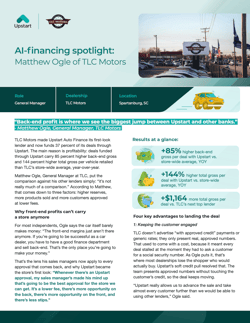
“Back-end profit is where we see the biggest jump between Upstart and other banks.” -Matthew Ogle, General Manager, TLC Motors
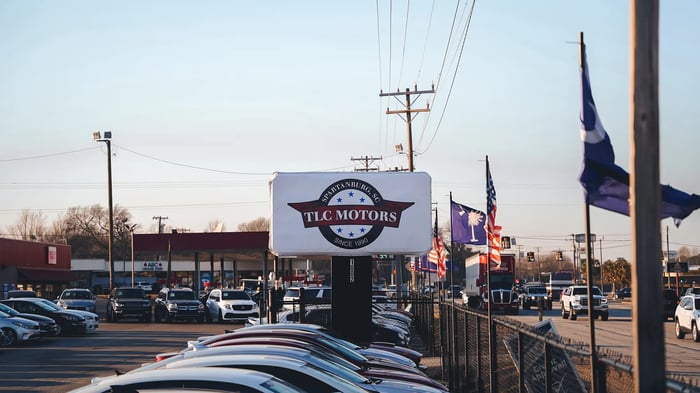
TLC Motors made Upstart Auto Finance its first-look lender and now funds 37 percent of its deals through Upstart.1 The main reason is profitability: deals funded through Upstart carry 85 percent higher back-end gross and 144 percent higher total gross per vehicle retailed than TLC's store-wide average, year-over-year.
Matthew Ogle, General Manager at TLC, put the comparison against his other lenders simply: “it’s not really much of a comparison.” According to Matthew, that comes down to three factors: higher reserves, more products sold and more customers approved at lower fees.
Why front-end profits can’t carry a store anymore
For most independents, Ogle says the car itself barely makes money: "The front-end margins just aren't there anymore. If you're going to be successful as a car dealer, you have to have a good finance department and sell back-end. That's the only place you're going to make your money."
That’s the lens his sales managers now apply to every approval that comes back, and why Upstart became the store’s first look: "Whenever there's an Upstart approval, my sales manager's made his mind up that's going to be the best approval for the store we can get. It's a lower fee, there's more opportunity on the back, there's more opportunity on the front, and there's less stips."
Four key advantages to landing the deal
1: Keeping the customer engaged
TLC doesn't advertise "with approved credit" payments or generic rates; they only present real, approved numbers. That used to come with a cost, because it meant every deal stalled at the moment they had to ask a customer for a social security number. As Ogle puts it, that's where most dealerships lose the shopper who would actually buy. Upstart's soft credit pull resolved that. The team presents approved numbers without touching the customer's credit, so the deal keeps moving.
"Upstart really allows us to advance the sale and take almost every customer further than we would be able to using other lenders," Ogle said.
.png?width=450&height=513&name=Frame%2025%20(1).png "Frame 25 (1)")
Results at a glance:

+85% higher back-end gross per deal with Upstart vs. store-wide average, YOY

+144% higher total gross per deal with Upstart vs. store-wide average, YOY

+$1,164 more total gross per deal vs. TLC’s next top lender
2: Higher approvals with first-time and thin file buyers
Upstart's model evaluates a broad range of variables per applicant beyond just a credit score. Ogle can point to where he sees the difference in two places in particular: first-time buyers and customers with a solid payment history regardless of their credit score. "I have seen some approvals that I just didn't expect," he said. Upstart’s accuracy shows up on structure. “There's a lot of negative equity out there, and banks just aren't giving themselves enough room to capitalize on people that could buy a car, but are upside down. Upstart's not really missing those people because of their LTV allowance," Ogle said.
3: Holding gross
Holding gross is critical throughout the sales and financing process. When a deal goes back for rehash, Ogle says bank fees are what his sales managers weigh hardest because any additional fee comes straight out of the margin the store keeps.
"While other banks can be competitive on the front-end allowance and back-end allowance, their fees can drive them out of consideration," Ogle said. It's the difference between rehashing into lower-fee approval and discounting the vehicle to make another lender's structure work. The fee is gross the store never sees, and by going with Upstart at a lower fee, there’s less pressure to give the car away.
4: Landing back-end gross
Ogle shared that he measures his finance office against back-end gross per vehicle retailed: the number that, in his words, means a store is "doing really, really well." TLC's store-wide average sits just under the industry average. On Upstart deals, the store is above it. "Back-end profit is where we see the biggest jump in profitability between Upstart and other banks," Ogle said.
When Ogle dug deeper into what was actually driving that gap, it came down to two things: reserve percentage and products per deal. TLC's finance office averages 1.9 products on an Upstart deal against 1.4 store-wide because the Upstart program and deal structure leaves room for TLC’s finance team to operate instead of squeezing them out.
The last critical mile: funding
Ogle is blunt about why funding speed belongs in a profitability conversation. "We can put 200 cars in the street every month, but if we don't get paid, then you have nothing."
TLC e-contracts every deal, and on average, its lenders fund in under two days; with Upstart, funding is often "next day or next morning." The dealership's controller, who Ogle says "doesn’t miss a penny,” notes that Upstart is the only lender that emails detailed reserve breakdowns, and that Upstart deals are typically funded before the finance office has even turned them in. Stips are the other half of that story, and they matter most for the customers who are hardest to document. Some banks, Ogle says, "want everything but blood." On Upstart deals, Ogle says a stip is rare enough that "my sales managers are surprised when they see them."
The result: fewer dollars sitting in contracts-in-transit and fewer deals falling through after the customer has driven off.
The bottom line
Upstart is now TLC's first look and its most profitable lender, and that advantage compounds across the whole deal:
-
A soft pull that keeps the customer engaged
-
Approvals that read beyond just the credit score
-
Fees that let the store rehash instead of discount
-
Stronger reserve and more products sold per deal
- Funding in about a day with rarely a stip attached.
In a market where front-end margin has all but disappeared, that combination is how TLC has grown profit per deal. After seeing the results, Ogle said, “I was kicking myself for not signing up sooner with Upstart.”
Ready to speed up financing and
convert more shoppers?